
Learn how SaaS affiliate programs work, how commission models differ, and which terms decide what publishers earn and what brands can afford to pay.
A SaaS affiliate program pays publishers, creators and other partners a commission when a click they send turns into a trial, subscription or purchase of a software product. For the software company, it is a way to buy customers only when they arrive. For the publisher, it is a way to earn from content, often with payments that repeat every billing cycle. The program's terms decide whether it works: commission structure, cookie window, hold period and the quality of the partners involved. This guide covers each, for both sides of the table.
How a SaaS affiliate program works
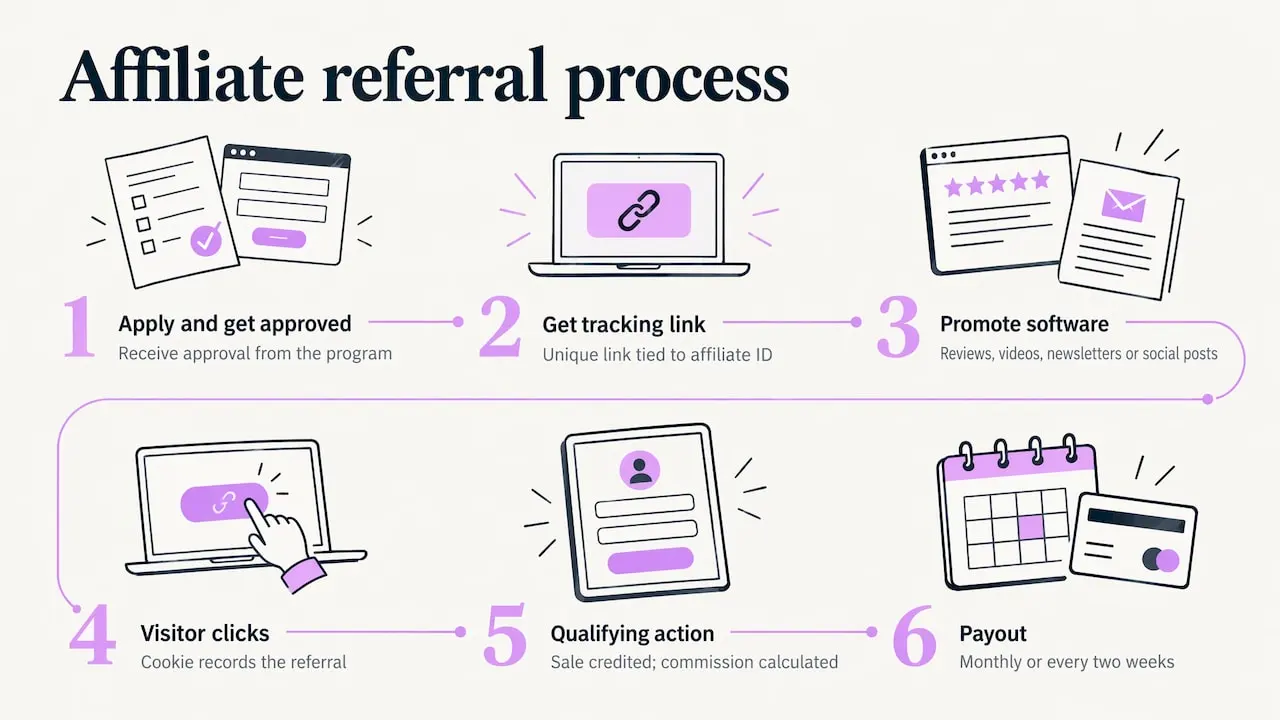
The mechanics are the same across most programs. A partner applies and, once approved, receives a unique tracking link tied to their affiliate ID. They promote the software in a review, comparison post, video, newsletter or social post. When a visitor clicks, a cookie or similar identifier records the referral. If that visitor later starts a qualifying action, the sale is credited to the partner and a commission is calculated. Payouts usually follow monthly or every two weeks, via PayPal, direct deposit or the network.
SaaS differs from physical-product affiliate marketing in one way that matters. A customer is not a single order. They are a subscription that renews, upgrades, downgrades and eventually cancels. Every term in a SaaS program is a decision about how to share that revenue stream between the vendor and the partner.
A real example shows the shape. One CRM vendor's partner guide describes affiliates copying referral links, visitor activity being attributed automatically, and commissions paid for up to 12 months per referral transaction, prorated if the referred customer cancels early.
Why software companies use affiliates
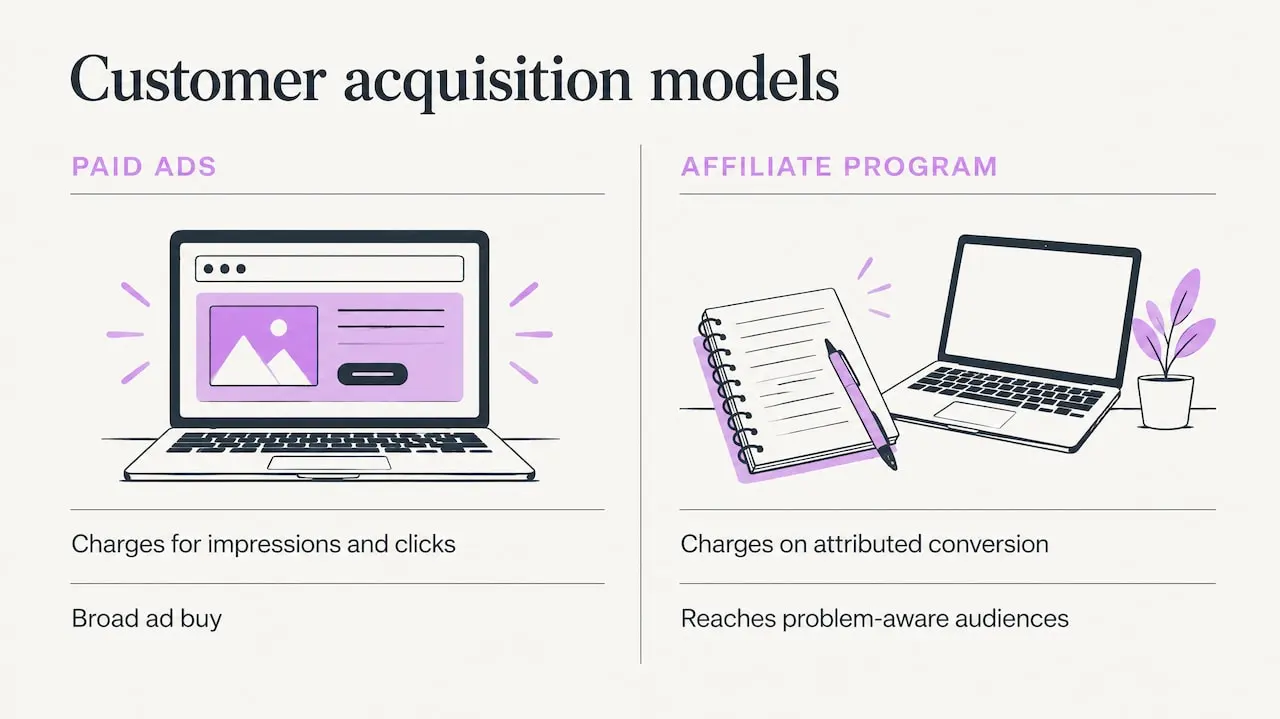
For a SaaS company, the appeal is cost structure. Paid ads charge for impressions and clicks whether or not anyone buys. An affiliate program charges when an attributed conversion happens. Partners also bring audiences that already read about the problem the software solves, such as a project-management blogger's readers or a marketing newsletter's subscribers. That is a more targeted audience than a broad ad buy usually reaches.
The trade-off is management. A program with a link page and no active partner work tends to produce a handful of sellers and a long tail of silent sign-ups. The work is in finding the right publishers, supporting them and watching the data.
If that is your situation as a brand, our guide on scaling an affiliate program without raising ad spend covers the operating side in more depth.
Recurring, one-time and hybrid commissions
For a publisher, this is the term that changes income more than any other, and it is also the one brands most often set without modeling it first. There are three common payout models, and they differ mainly in how long the money keeps coming.
The recurring model pays a percentage of each subscription payment, either for a fixed period or for the entire life of the customer. For example, 25% of a $200 monthly plan comes to $50 per month, which adds up to $1,200 over two years.
The one time model pays only once, either as a flat amount or as a percentage of the customer's first payment. A typical case is $500 for each closed annual contract, with nothing further after that.
The hybrid model combines the two, offering an upfront bonus along with a smaller recurring percentage. For instance, a brand might pay $250 up front plus 15% of each payment for 12 months, which gives the publisher some immediate return while still rewarding customers who stay.
The examples above come from a guide to SaaS commission structures. Here is a simple way to compare offers yourself. Take a $20/month product and a customer who stays three years, which is $720 in total payments. A 50% commission for 12 months pays the affiliate $120. A 40% commission for life pays $288. The lower rate wins because it lasts longer. Always multiply rate by duration by the price before comparing programs.
Which model suits which product
Recurring commissions fit products with low churn and steady billing, because partner and vendor both gain as the customer stays. One-time payments fit high-ticket software sold on annual contracts, where a single payment is large. Hybrids suit programs that want to reward the sign-up itself while keeping the partner interested in retention. A brand choosing between them should start from its own customer lifetime value and payback period, then set the rate it can afford at that point.
Terms both sides should read before signing
The headline rate is one line of a longer agreement. These are the clauses that decide what actually gets paid:
Cookie window. How long after a click a conversion still counts. Typical B2B SaaS windows run 60 to 90 days. Software with a long evaluation period needs a long window.
Hold period. Commissions are generally held for a refund window, commonly 30 to 60 days, before they are approved.
Refund and chargeback clawback. A refunded payment normally reverses the commission.
Commission duration. Twelve months, 24 months or lifetime, and what happens at upgrades and downgrades.
Payout threshold and method. Many programs pay once the approved balance passes a minimum, so a small publisher can wait several months for a first payment.
Attribution rules. What happens when two partners touch the same customer, and whether coupon sites or brand-search ads can take credit from the publisher who made the introduction.
Brands should write these down in plain language. Publishers should read them before building content around a product, because a month of writing is wasted if the cookie lasts a day. Our publisher payouts and commission policy sets out how payouts work on our platform.
What publishers can realistically earn
SaaS has a reputation for generous percentages, and the rates are real: the CompareEPC analysis found an average published rate of 22.5% across 139 program listings. But the same analysis found that the median EPC among programs with positive data was $0.19. High rates on low-priced or freemium products produce small payments per click. The programs with the strongest documented EPCs sold clearly defined, higher-priced products to audiences with specific purchase intent.
So the useful question for a publisher is not which program pays the highest rate. It is which product your readers already want to buy, at a price where a percentage becomes real money.
Income across the industry is uneven. A survey cited by Influencer Marketing Hub, reported by an agency, found 57.55% of affiliate marketers earn under $10,000 a year and 3.78% earn more than $150,000. In the UK, the APMA's survey found 80% of responding influencers earn under £5,000 a month from affiliate activity. Treat these as a reminder that results follow audience fit and consistency, not the program name.
Choosing programs that fit your audience
Start with what you already cover. A review or comparison of a tool your readers are researching converts better than a generic roundup.
Check the price point. A 30% commission on a $9 plan pays about $2.70 per month per customer. The same rate on a $199 plan pays about $60.
Prefer clear tracking. You need to see clicks, conversions and commission status without emailing anyone.
Mix durations. Keep at least one recurring program in the mix so earnings build as customers stay.
What brands should look for in partners and tracking
For a SaaS brand, recruiting is the part that decides results. Partners should be chosen for audience fit, content quality and the kind of intent their readers show, not for follower counts alone. Once they join, the questions are:
Is every click, trial and paid conversion tracked in real time, with commission status visible to both sides?
Is fraudulent traffic, such as self-referrals or incentivized sign-ups, caught before it is paid?
Can you measure net-new customers, not just attributed ones, and see retention by partner source?
Is payout handled reliably, so good partners stay?
These are the jobs a platform takes off your hands. Rinkuya is an affiliate marketplace that aggregates offers from multiple affiliate networks in one place. It uses AI-powered partner matching, provides real-time click, conversion and commission tracking, applies AI-driven fraud detection, and reviews publishers and traffic sources. It handles publisher payouts too. More than 3,000 brands across more than ten countries use it. For the wider picture of how these platforms connect brands and publishers, see our guide to the affiliate partnership platform, and for sourcing partners see publisher recruitment services.
Start a SaaS affiliate program with Rinkuya
If you run a software product and want partners who match your buyers, our advertiser page explains how to launch and scale a program with tracking, fraud detection and partner matching in one platform. Set up your program as an advertiser.
If you create content and want SaaS offers to promote, the publisher page shows how to browse offers from multiple networks in one place. Creators building an audience on social or video can start from our influencer affiliate marketing page.
Disclosure rules for SaaS affiliates
In the United States, the FTC requires you to make clear when you have a financial relationship with a brand you recommend. Its guidance says to disclose any financial, employment, personal or family relationship, which includes earning commission on an affiliate link. The same guidance says the disclosure should sit with the endorsement itself, be hard to miss, and not be buried in a hashtag group, a profile page or behind a "more" click. It also says that posting from abroad does not exempt you if the post can reasonably be expected to affect US consumers.
Other countries have their own rules, and the UK, EU and others apply different wording and enforcement. Brands running international programs should give partners clear disclosure language, and publishers should check the rules where their audience lives. Our affiliate marketing compliance guidelines cover expectations for advertisers and publishers on the platform.
A short checklist before you join or launch
For publishers: confirm the commission model and duration, the cookie window, the hold period, the payout minimum, and whether the product's price suits your audience. Add a disclosure beside every affiliate link.
For brands: model commission against customer lifetime value, set a hold period that matches your refund window, define attribution rules for coupon and brand-search traffic, and put effort into activating partners, since a program's results depend on how many partners actively promote.
If you are new to the channel, affiliate networks for beginners walks through a first campaign step by step.
FAQ
What is a SaaS affiliate program?
It is an arrangement where a software company pays partners for sending customers. Each partner gets a unique tracking link, and when a visitor who used it starts a qualifying action such as a trial, subscription or purchase, the partner earns a commission. Many programs pay a percentage of each subscription payment.
How much do SaaS affiliate programs pay?
Published rates commonly sit around 20% to 30%, and the average in one 97 brand analysis was 22.5%. What you earn depends on the product's price, how long commission lasts and how well your audience converts. A lower rate for life can beat a higher rate for 12 months.
Is recurring or one-time commission better?
Recurring commission usually pays more in total on products customers keep for years, since you earn on every billing cycle. One-time payments suit high-priced annual contracts. Compare offers by multiplying rate, price and duration, as in the $120 versus $288 example above.
Do I have to disclose affiliate links?
Yes, in the US. The FTC says you should disclose a financial relationship with a brand clearly, next to the endorsement, in a way people will notice. Check the rules of the countries where your readers live too.