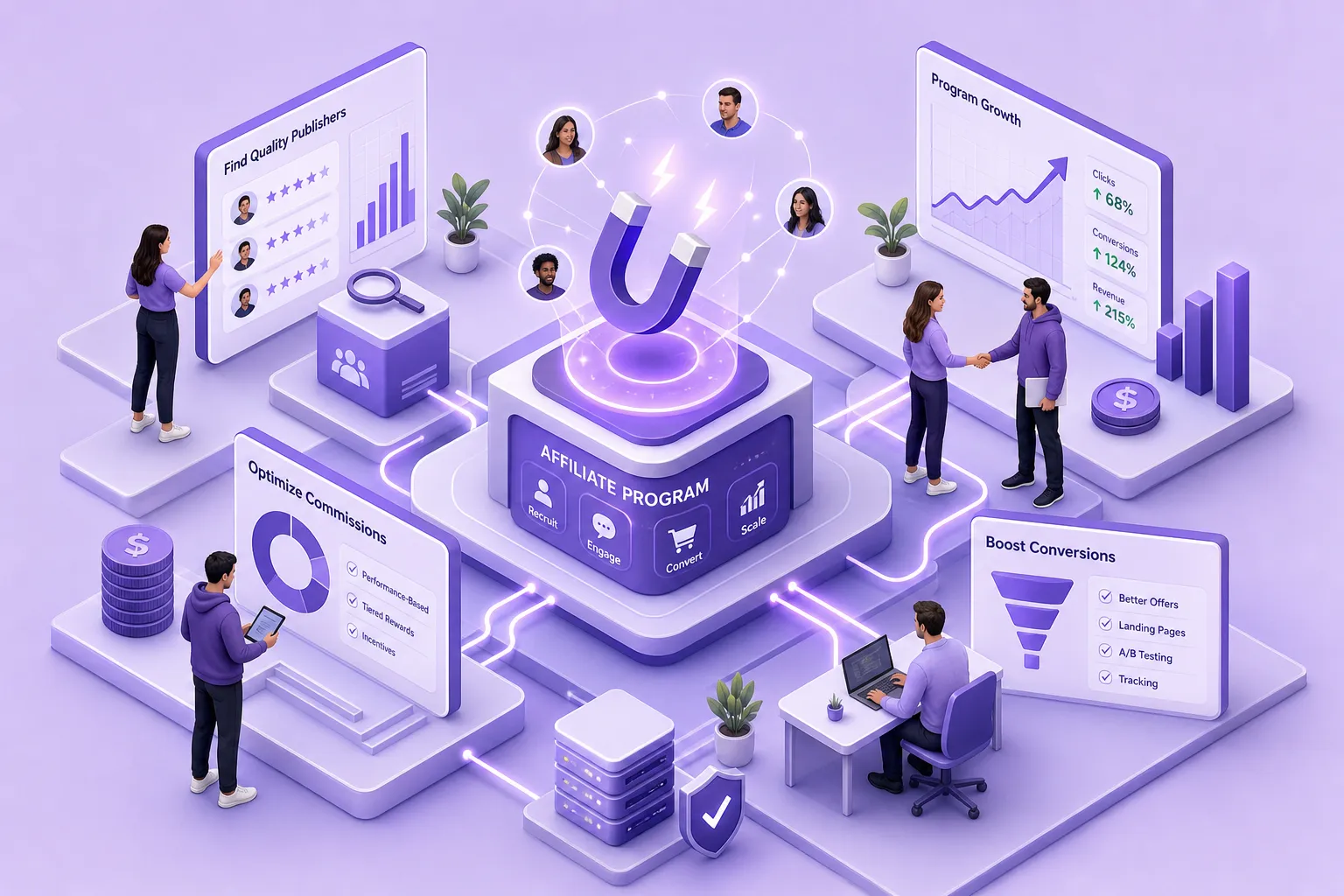
Scale your affiliate program without increasing ad spend by recruiting high-quality publishers, optimizing commission structures, accelerating partner activation, improving conversions, and leveraging organic channels like SEO and email.
How do I scale my affiliate marketing program without increasing ad spend? The answer comes down to five levers: recruiting higher-fit publishers, restructuring commission incentives, activating partners faster, converting affiliate traffic more efficiently, and amplifying through non-paid channels like email and SEO content, none of which require new ad budget. Brands that manage all five levers from a single platform move faster and waste less time on manual coordination across disconnected tools and networks.
This guide covers each lever with specific tactics, benchmark numbers, and measurement approaches you can put to work from day one. If you've been treating your affiliate channel as a set-it-and-forget-it revenue source, these strategies will show you exactly where the growth is sitting untouched.
Key takeaways
Recruit for relevance, not reach: Niche publishers whose audiences already buy in your category consistently outperform large but misaligned partners on conversion.
Tie payouts to realized value: Tiered, performance-based commission structures reward scale while protecting your contribution margin at every threshold.
Activate fast or lose partners: The first 30 to 60 days after approval determine whether a new affiliate ever generates a sale. A structured launch kit dramatically shortens time-to-first-sale.
Fix message match before anything else: Aligning your landing page to the affiliate's exact promotion angle is the highest-ROI conversion test available, with reported lifts of 20 to 50 percent.
Non-paid channels compound: Email drives roughly 15 percent of affiliate sales; SEO-driven content accounts for about 25 percent of affiliate conversions and keeps working without ongoing spend.
Measure incrementality, not just attribution: Separating genuinely new customers from last-click captures shows the true value your affiliate program delivers.
Who should you actually recruit to scale your affiliate program without increasing ad spend?
Finding niche publishers who already own your buyers' attention
The highest-ROI recruits aren't the affiliates with the biggest audiences. They're the publishers whose audiences are already buying in your category. A fitness supplement brand partnering with a 10,000-subscriber running newsletter will almost always outperform a generic lifestyle blog with 10 times the traffic, because the intent gap is smaller and the trust is higher.
The best places to find these publishers are competitor review pages, comparison articles, niche newsletters, YouTube tutorials, and category-specific podcasts. Prioritize audience relevance, engagement, and purchase intent over raw follower count. Niche authority sites commonly achieve conversion rates of 4 to 6 percent compared to generic display placements, which makes their traffic worth significantly more per click even at a higher commission rate.
How AI partner matching cuts through the discovery problem
Manually prospecting publishers across 15 or more networks is slow, inconsistent, and misses the partners most likely to convert your specific audience. That's the core problem Ai Powered Partner matching solves. Rather than relying on directories and inbound applications, an AI system analyzes content themes, audience characteristics, conversion behavior, and niche fit to surface publishers who match your brand's goals, not just your category keywords.
At Rinkuya, our AI-powered partner matching connects brands with verified publishers based on niche, audience fit, and business goals, surfacing relevant partners across a network of 2,000-plus active publishers without manual prospecting. Because our platform aggregates 15 plus affiliate marketing network into a single marketplace, the discovery layer covers ground that individual network searches miss entirely. For brands looking to scale without adding headcount, this is the starting point that replaces hours of outreach research with a smarter, automated shortlist.
What commission structure actually encourages scale without killing margin?
Tiered and performance-based models that reward real results
The most scalable commission structure isn't the highest rate. It's one tied to realized value with built-in quality gates and volume thresholds.
Vertical benchmark rate StructureEcommerce / DTC~8.4% of net salesPercentage of eligible order value; product-level tiers for margin variationB2B SaaS20–30% of subscription revenueRecurring share for 12 months; retention gate after 60–90 days
Tiered commissions are the core mechanism for scaling without permanently locking in an uneconomic rate. A practical structure starts with a base payout for all partners, then adds a 15 to 30 percent uplift at meaningful conversion volume thresholds, provided quality metrics like refund rate and new-customer percentage stay within defined limits. Temporary accelerators, such as 30 to 90-day commission boosts for product launches or seasonal campaigns, drive short-term scale without creating a permanent margin liability.
Protecting contribution margin while growing payout volume
Frame your maximum allowable payout from unit economics, not from what competitors are offering. Calculate on net sales after discounts, returns, shipping, and taxes. Hold commission release until after the refund window closes, claw back reversed transactions automatically, and exclude coupon or brand-search traffic that would have converted anyway. As a planning guideline, aim to keep total affiliate cost below roughly 20 to 40 percent of affiliate-generated revenue while targeting at least a 20 to 30 percent contribution margin after commissions and operating costs.
How do you turn newly approved affiliates into active, converting publishers?
The launch kit that gets affiliates publishing within 30 to 60 days
The first 30 to 60 days after approval determine whether a new affiliate ever generates a single conversion. Many brands send a welcome email with a tracking link and then struggle to understand why so many approved partners go silent. The fix is a structured launch kit delivered immediately after approval, ideally within an hour, with one clear first action built in.
A high-converting launch kit includes:
Unique tracking and deep links
Product images, logos, and short-form video
Suggested headlines, CTAs, email copy, and social captions
Comparison pages, FAQs, and an exclusive discount code for the launch period
Examples of content angles that have already driven conversions
Providing proven content frameworks alongside creative assets dramatically shortens time-to-first-sale because you're removing every decision a new affiliate would otherwise have to make on their own.
Using a centralized dashboard to track activation and catch dormancy early
Knowing which affiliates are building content and which went cold after approval is impossible without visibility into real-time activity. Rinkuya's real-time dashboard consolidates clicks, conversions, commissions, and campaign performance across all active partners in one view, so your team can see exactly which newly approved publishers need a nudge before they disengage permanently. Without centralized tracking, program managers spend hours pulling data from multiple network logins rather than acting on what the data shows.
Which conversion tests give affiliate traffic the biggest lift?
Message match and offer framing tests with real benchmark data
The highest-impact test for most affiliate programs isn't redesiging the landing page. It's aligning the page's headline and offer with the exact angle the affiliate used to send the visitor. When a publisher promotes "best budgeting app for freelancers," the landing page should reflect that positioning directly, not generic brand copy. This message-match principle consistently produces the strongest page-level gains, with reported lift ranges of 20 to 50 percent, and substantially higher in cases where the original mismatch is severe.
After message match, offer framing tests are the next highest-leverage opportunity. Test percentage savings against dollar savings, free trials against guarantees, and bundles against single-product offers. These framing tests have reported roughly 5 to 25 percent conversion improvements and cost nothing beyond the time to set up the test. Prioritize both of these before any visual overhaul of your landing pages.
Form friction, CTA treatment, and mobile speed as the fastest wins
Form optimization is consistently among the strongest test categories available, with reported lifts around 10 to 35 percent. Reduce unnecessary fields, enable autofill, and remove avoidable checkout steps. For CTA copy, outcome-oriented text like "Claim the offer" or "Get my quote" outperforms generic "Submit" in almost every documented test. Page load speed is especially critical for affiliate traffic arriving on mobile; even a one-second delay can meaningfully reduce conversions.
The right sequencing matters. Diagnose the funnel first by reviewing your page conversion rate, earnings per click (EPC), and device split. Then test message match, then offer framing, then form friction, then CTA treatment. Don't start with button color.
Scale your affiliate program on a budget: non-paid channels that compound over time
Email, SEO content, and creator partnerships as zero-budget amplifiers
Three non-paid channels reliably lift affiliate revenue without adding to your media budget. Email drives roughly 15 percent of affiliate sales, and affiliates using email have been reported to earn 66.4 percent more than those without it (newmedia.com). SEO-driven content accounts for about 25 percent of affiliate conversions and compounds without ongoing spend, making it the most durable channel in the program. Micro-creator partnerships average 4.5 percent conversion on affiliate links, nearly double traditional display campaigns; in one documented case study, a structured creator campaign produced a 34% increase in affiliate revenue, a 24% increase in clicks, and a 38% increase in transactions (Acceleration Partners).
The practical implication for brands is to direct affiliates toward these content formats rather than paid placements. Build email swipe copy into your launch kit. Prioritize publisher partners who run review sites, niche newsletters, and YouTube tutorials. Reserve any creator co-investment for partners with demonstrated audience relevance and engagement, not broad reach.
Measuring incremental revenue, not just attributed affiliate sales
Attributed revenue and incremental revenue are not the same number, and the gap matters enormously for proving ROI. A coupon affiliate who intercepts a customer who already decided to buy isn't generating new revenue; they're capturing a commission on a sale that would have happened anyway. Separating these streams requires unique links and codes per partner and placement, new-customer rate tracking, holdout or geo-based tests for larger creator campaigns, and separate reporting for coupon, brand-search, and content-driven traffic.
A realistic planning assumption for a well-executed creator or content initiative is roughly 10 to 35 percent incremental affiliate revenue growth. Rinkuya's real-time analytics make all of this visible from a single dashboard, without manually stitching together data from multiple network accounts. Rinkuya has 3,000-plus verified brands and 2,000-plus active publishers across 190-plus countries, and uses this unified view to put performance data in front of your team the same day it surfaces, rather than waiting for weekly reports from disconnected network logins.
Build the system, then let it scale
If you're still asking how do I scale my affiliate marketing program without increasing ad spend, the answer is the same five levers, applied consistently: recruit higher-fit publishers, pay for performance with margin-safe commission structures, activate partners fast with a structured launch kit, convert affiliate traffic more efficiently through message-match and friction-reduction tests, and use non-paid channels to compound results over time. None of these tactics require a bigger budget. They require better systems and smarter matching.
That's exactly where Rinkuya fits in. Our AI-powered partner discovery surfaces the right publishers from a network of 2,000-plus active partners. Our real-time dashboard tracks every click, conversion, and commission across all active campaigns. AI fraud detection protects every conversion, and our single platform eliminates the need to manage multiple network accounts separately. We offer a free-to-start model with 99.9 percent uptime and a simplified four-step onboarding, so you can go from approved to active without a complicated technical setup.
The brands growing their affiliate revenue without growing their ad spend aren't spending more. They're measuring better, recruiting smarter, and removing friction at every step. If you're ready to put these five levers to work, reach out to our team and get started with Rinkuya today.
Frequently Asked Questions
How do we tell if an affiliate is driving new customers or just capturing sales that would have happened anyway?
You measure incrementality by separating attributed revenue from genuinely new-customer revenue. Use unique links and codes per partner and placement, track new-customer rate, run holdout or geo-based tests for larger campaigns, and report coupon, brand-search, and content-driven traffic separately to see the true incremental contribution.
How large is the publisher and brand coverage available through your platform?
Our platform aggregates a network that includes 2,000-plus active publishers and 3,000-plus verified brands across 190-plus countries. That unified marketplace surfaces partners without manual prospecting across 15-plus networks.
What onboarding and reliability can we expect when we start using your platform?
You can start with a free-to-start model and a simplified four-step onboarding process. The platform delivers 99.9 percent uptime and a single dashboard so you can go from approved to active without complicated technical setup.